

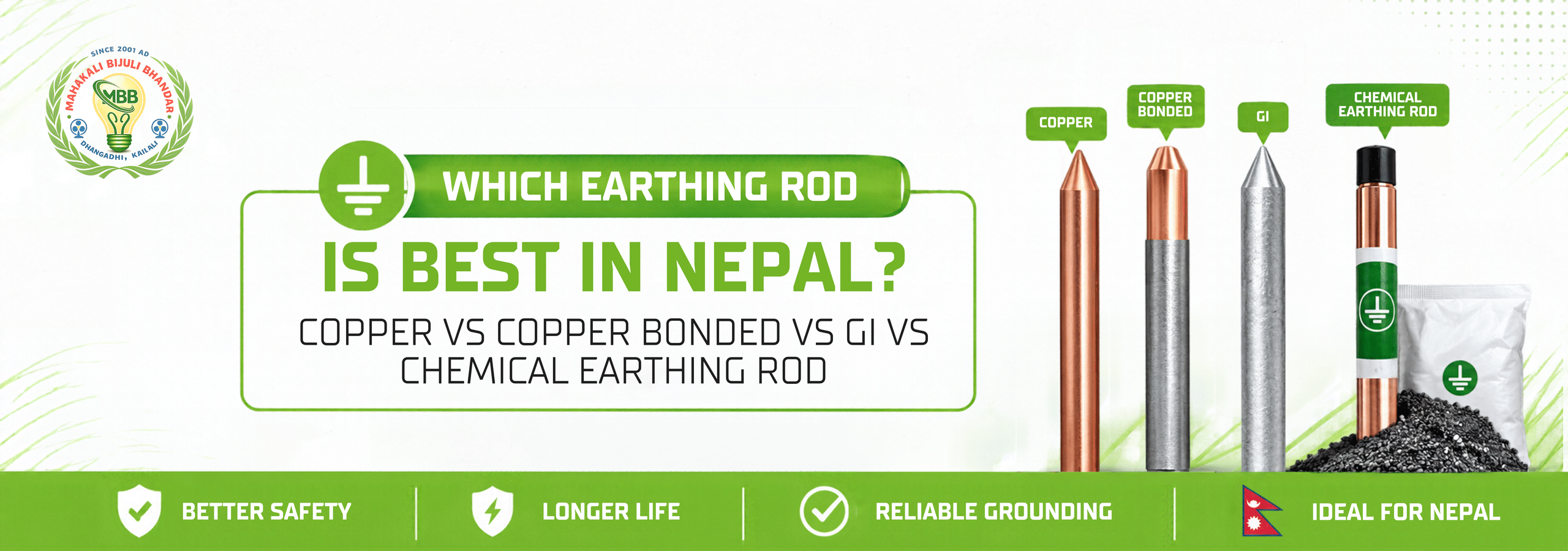
Choosing the right earthing rod in Nepal is not simply a matter of buying the cheapest electrode. The correct earthing system depends on soil conditions, the type of electrical installation, required earth resistance, electrode material, installation method and long-term maintenance.
For homeowners, electricians, contractors and businesses in Dhangadhi, Kailali, Kanchanpur and across Sudurpaschim, questions such as “Which earthing rod is best for a home in Nepal?”, “What is the earthing rod price in Nepal?”, and “Is chemical earthing better than copper bonded earthing?” are becoming increasingly common.
At Mahakali Bijuli Bhandar, we have been supplying electrical products in Dhangadhi since 2001. With more than two decades of experience serving homeowners, electricians, contractors and businesses, we understand that a good earthing system should be selected according to the actual site—not simply by choosing the most expensive rod.
In this guide, we explain the major types of earthing rods available in Nepal, their advantages and limitations, approximate use cases, factors affecting price, and how to choose the right earthing solution for your home, shop, commercial building, solar system or industrial installation.
Important: Earthing is a safety-critical electrical installation. The correct electrode, conductor size, number of electrodes and target resistance should be determined according to the electrical system, soil conditions, applicable standards and site requirements by a qualified professional.
Table of Contents
Quick Answer: Which Earthing Rod Is Best in Nepal?
There is no single earthing rod that is automatically best for every property.
For many residential and commercial installations, a properly specified copper-bonded electrode used as part of a well-designed earthing system can provide a good balance between durability, conductivity and cost.
Where soil conditions make it difficult to achieve the required earth resistance, an earth-enhancement or chemical earthing system may be considered as part of the overall design.
GI earthing rods remain a practical and economical option for suitable installations, while solid copper electrodes offer excellent conductivity but generally have a higher material cost.
The important point is this:
The best earthing system is the one that achieves the required electrical performance reliably under the actual soil and installation conditions.
What Is an Earthing Rod?
An earthing rod, also called a grounding electrode, is a conductive electrode installed in the ground and connected to an electrical earthing system.
Its purpose is to provide a path between the electrical installation and the earth so that fault currents and other unwanted electrical currents can be safely conducted away from exposed conductive parts and the electrical system.
A complete earthing system normally involves much more than the rod itself. Depending on the installation, it can include:
- Earthing electrode or rod
- Earth conductor
- Clamps or connectors
- Inspection chamber
- Earth-enhancement material where required
- Bonding connections
- Lightning protection connections where applicable
- Testing and periodic inspection
Therefore, buying a high-quality rod alone does not automatically guarantee a good earthing system.
Why Is Proper Earthing Important in Nepal?
A properly designed earthing system plays an important role in electrical safety.
It can help:
- Reduce dangerous touch voltages during faults
- Provide a suitable path for fault current
- Improve the operation of protective devices
- Protect electrical equipment
- Support lightning and surge protection systems where appropriately designed
- Improve the overall safety of residential, commercial and industrial installations
Soil conditions are especially important.
Two buildings using the same type and size of electrode can produce different earth resistance readings because soil resistivity, moisture, temperature, electrode depth, electrode arrangement and surrounding ground conditions can vary considerably.
This is why an earthing solution should not be selected only from a catalogue or based on the rod price.
Types of Earthing Rods Available in Nepal
The most common electrode options you may encounter include:
- GI earthing rod
- Copper-bonded earthing rod
- Pure copper earthing electrode
- Chemical or earth-enhancement earthing system
Let’s look at each one.
1. GI Earthing Rod
GI means Galvanized Iron. A GI electrode uses steel or iron protected with a zinc coating to improve corrosion resistance.
GI electrodes are widely used in electrical installations and can be an economical choice where the installation conditions and design are suitable.
Advantages of GI earthing rods
- Generally lower material cost than solid copper
- Widely available
- Suitable for many conventional earthing installations
- Good mechanical strength
- Can be used with appropriate GI earthing conductors and accessories
Limitations
The long-term performance of a GI electrode depends heavily on:
- Soil chemistry
- Moisture
- Corrosion conditions
- Coating quality
- Installation method
- Electrode dimensions
A GI electrode should therefore not be rejected simply because it is cheaper, nor should it be assumed to last a fixed number of years in every location.
Best suited for
GI electrodes may be considered for:
- Residential installations
- Commercial installations
- Electrical distribution systems
- Suitable project applications
- Installations where GI is specified by the project design
2. Copper-Bonded Earthing Rod
A copper-bonded earthing rod generally consists of a steel core with a bonded copper layer around it.
The steel core provides mechanical strength, while the copper surface provides good electrical conductivity and corrosion resistance.
Copper-bonded electrodes are commonly used in grounding applications and are also found in Nepalese procurement specifications. For example, Nepal Electricity Authority procurement documents have specified copper-bonded earthing rods alongside GI electrodes and ground-enhancement materials.
Advantages
- Good conductivity
- Strong mechanical construction
- Better corrosion resistance than an unprotected steel electrode
- Available in different diameters and lengths
- Suitable for residential, commercial and industrial applications when properly specified
- Good balance between performance and material cost
What should you check?
When purchasing a copper-bonded rod, don’t look only at the words “copper bonded.”
Check:
- Rod diameter
- Rod length
- Copper layer thickness
- Bonding quality
- Steel core quality
- Manufacturer specifications
- Accessories and clamps
- Intended installation method
Best suited for
Copper-bonded rods can be a strong choice for:
- Homes
- Shops
- Offices
- Commercial buildings
- Industrial installations
- Solar installations where appropriate
- Projects requiring durable grounding electrodes
3. Pure Copper Earthing Rod
A solid copper earthing electrode uses copper throughout the electrode rather than a steel core with a copper layer.
Copper offers excellent electrical conductivity and good corrosion resistance, but the material cost can be considerably higher.
Advantages
- Excellent electrical conductivity
- Strong corrosion resistance in suitable environments
- Long-term performance potential
- Useful for specialized electrical and grounding applications
Limitations
- Higher material cost
- Copper price can significantly affect the overall cost
- Mechanical requirements and site conditions still need to be considered
- Not automatically necessary for every residential installation
For most homeowners, the question should not simply be “Is pure copper better?”
The better question is:
“Does the installation actually require a solid copper electrode, or would a properly specified copper-bonded electrode provide the required performance at a better overall cost?”
4. Chemical Earthing / Earth-Enhancement System
The term chemical earthing is commonly used in the market for earthing systems that use an electrode together with an earth-enhancement or conductive backfill material.
It is important to understand that chemical earthing is not simply a special type of rod.
A complete system can include:
- Earthing electrode
- Conductive or earth-enhancement compound
- Earth conductor
- Connection hardware
- Inspection arrangement
- Properly prepared electrode installation
Nepalese public procurement documents demonstrate that earth-enhancement materials and copper-bonded electrodes are used as components of specified earthing systems.
Why use earth-enhancement material?
In high-resistivity soil or difficult ground conditions, suitable earth-enhancement materials may help improve the contact between the electrode and surrounding soil.
However, the material should be selected carefully.
A chemical compound is not a magic solution that automatically guarantees a particular resistance value.
The result still depends on:
- Soil resistivity
- Electrode geometry
- Installation depth
- Number and arrangement of electrodes
- Backfill properties
- Moisture conditions
- Conductor connections
- Testing
Best suited for
Earth-enhancement systems may be useful where:
- Soil resistivity is high
- Conventional electrodes do not achieve the required performance
- The project specification calls for enhanced earthing
- Space or soil conditions make conventional arrangements difficult
Copper vs Copper-Bonded vs GI vs Chemical Earthing
| Feature | GI Earthing Rod | Copper-Bonded Rod | Pure Copper Rod | Chemical / Enhanced Earthing |
|---|---|---|---|---|
| Basic construction | Galvanized steel/iron | Copper bonded steel | Solid copper | Electrode + enhancement material |
| Conductivity | Good | Very good | Excellent | Depends on electrode/system |
| Corrosion resistance | Depends on coating and soil | Generally good | Generally excellent | Depends on electrode and compound |
| Material cost | Lower | Medium | Higher | Depends on complete system |
| Mechanical strength | Good | Very good | Good | Depends on electrode |
| Maintenance | Site dependent | Site dependent | Site dependent | Site/system dependent |
| Suitable for homes | Yes, where properly designed | Yes | Yes, where justified | Yes, where site conditions require |
| Suitable for commercial use | Yes | Yes | Yes | Yes |
| Suitable for industrial projects | Yes | Yes | Yes | Yes |
| Best choice | Depends on site | Strong general-purpose option | Specialized/high-conductivity applications | Difficult/high-resistivity conditions |
Note: This comparison is a general guide. Actual electrode selection should be based on the electrical design, soil conditions, project specifications and applicable standards.
Which Earthing Rod Is Best for a Home in Nepal?
For a typical home, don’t select an earthing rod based only on price.
A properly specified copper-bonded earthing rod is often a practical choice because it combines mechanical strength, copper conductivity and corrosion resistance.
However, if soil conditions make it difficult to achieve the required earth resistance, an earth-enhancement system may be considered.
For a new house, we recommend considering these factors before purchasing:
- Soil condition
- Required earth resistance
- Electrical system type
- Building size
- Presence of sensitive electronics
- Solar installation
- Lightning protection
- Available installation space
- Electrode material
- Future maintenance requirements
For a typical residential installation
A properly installed copper-bonded electrode can be a practical option.
For difficult soil conditions
Consider an appropriately designed earth-enhancement system.
For specialized installations
Hospitals, industrial plants, data/communication equipment, solar installations and other critical systems may require a more detailed earthing design.
Earthing Rod Price in Nepal: What Determines the Cost?
If you are searching for earthing rod price in Nepal, you will notice that prices vary significantly between products and suppliers.
There is no single nationwide price because the total cost depends on the specification.
Important factors include:
1. Electrode material
GI, copper-bonded and solid copper electrodes have different material costs.
2. Rod length
A longer electrode generally requires more material and can cost more.
3. Rod diameter
Larger-diameter electrodes generally require more material.
4. Copper thickness
For copper-bonded rods, the copper layer specification can affect cost.
5. Earth-enhancement compound
Chemical or enhanced earthing systems may include additional conductive/backfill materials.
6. Accessories
The total installation may require:
- Clamps
- Connectors
- Earth wire
- GI strip
- Copper strip
- Inspection chamber
- Protection pipes
- Other installation accessories
7. Installation
The final project cost can also depend on excavation, drilling, labour and site conditions.
Chemical Earthing Rod Price in Nepal
People often search for chemical earthing rod price in Nepal expecting one fixed number.
In reality, you should ask for the price of the complete required earthing system, not just the rod.
For example, a quotation may depend on:
- 6 ft, 8 ft or 10 ft electrode
- Electrode diameter
- Copper-bonded or GI construction
- Earth-enhancement compound quantity
- Earthing conductor
- Clamp and connection accessories
- Installation requirements
For this reason, Mahakali Bijuli Bhandar recommends confirming the exact specification before comparing prices.
Our current product catalogue includes a 6 ft copper-bonded chemical earthing rod / grounding electrode intended for residential, commercial and industrial applications.
For the latest price and availability, contact Mahakali Bijuli Bhandar rather than relying on an old online price.
Why the Cheapest Earthing Rod Is Not Always the Cheapest Solution
Suppose two products have different prices.
The cheaper rod may initially save money, but the complete project cost can also depend on:
- Installation quality
- Electrode life
- Corrosion
- Maintenance
- Earth-enhancement requirements
- Replacement
- Testing
- Accessibility for future inspection
This is why experienced electricians and contractors compare total installation performance and lifecycle cost, not just the purchase price of the rod.
What Earth Resistance Should You Aim For?
This is one of the most misunderstood parts of earthing.
There is no single resistance number that can be applied blindly to every electrical installation.
The acceptable value depends on the electrical system, protective arrangement, equipment, applicable standards and project requirements.
For example, recent Nepalese project specifications commonly use 5 Ω as a maximum requirement for particular installations, but that does not mean 5 Ω is a universal requirement for every electrical system.
The current BIS listing identifies IS 3043:2018 as the second revision of the Code of Practice for Earthing.
Therefore:
Do not choose an earthing rod simply because someone promises “1 ohm” or “2 ohms.”
The correct target should come from the actual electrical design and applicable requirements.
How to Test Earthing
After installation, earth resistance should be tested using an appropriate earth resistance tester by a competent person.
Testing helps determine whether the installed earthing system is performing as intended.
A proper check should consider:
- Earth electrode resistance
- Connection quality
- Earth conductor continuity
- Condition of clamps and joints
- System bonding
- Changes in site conditions
For important installations, periodic inspection and testing should be part of the maintenance plan.
Common Earthing Mistakes to Avoid
1. Choosing the rod only by price
A cheaper rod is not necessarily the better solution.
2. Assuming a longer rod automatically means better earthing
Electrode length matters, but soil conditions and the complete electrode arrangement matter too.
3. Using poor-quality clamps
A good electrode with a poor connection can still create a serious problem.
4. Ignoring corrosion
The electrode and connections should be suitable for the surrounding soil environment.
5. Assuming chemical compound guarantees a fixed resistance
No compound can guarantee the same resistance in every soil and installation.
6. Installing without testing
Earthing should be tested after installation.
7. Treating lightning protection and equipment earthing as exactly the same thing
Lightning protection, protective earthing and system earthing can interact but may have different design requirements.
8. Copying another building’s earthing design
A system that works at one property may not produce the same result at another property.
Earthing for Solar Systems in Nepal
Solar PV installations require careful consideration of earthing and bonding.
Depending on the system, this can involve:
- PV module frames
- Mounting structures
- Inverter
- AC system
- DC equipment
- Surge protection
- Lightning protection
- Main electrical earthing
Recent Nepalese project specifications include copper-bonded rods and earth-enhancement compounds for solar installations, while also specifying earth-resistance requirements for particular systems.
Therefore, don’t simply install a chemical earthing rod because it is marketed as “best for solar.”
The entire solar earthing and protection system should be designed according to the equipment and project requirements.
How to Choose an Earthing Rod: A Practical Checklist
Before buying an earthing rod, ask these questions:
1. What is the application?
- Home
- Shop
- Office
- Factory
- Hotel
- School
- Hospital
- Solar system
- Industrial equipment
2. What is the soil like?
- Moist
- Dry
- Sandy
- Rocky
- Gravelly
- High-resistivity
3. What electrode material is specified?
- GI
- Copper bonded
- Copper
- Other approved electrode type
4. What size is required?
Check:
- Length
- Diameter
- Material
- Copper coating specification where applicable
5. Is earth-enhancement material required?
Don’t add it automatically. Determine whether it is actually appropriate for the site and design.
6. How will the electrode be tested?
Make sure the installation can be tested after completion.
7. Who is installing it?
Use a qualified electrician or electrical professional for safety-critical work.
Where to Buy Earthing Rods in Dhangadhi, Kailali?
If you are searching for earthing rods in Dhangadhi, earthing rod price in Kailali, or electrical supplies in Sudurpaschim, Mahakali Bijuli Bhandar provides electrical products and product-selection support from its store at Dhangadhi-2, Chauraha, Kailali. The business has operated since 2001 and serves residential, commercial and project customers.
Our online catalogue includes an Earthing & Safety category with earthing rods, earthing clamps and earthing wire.
We can help with:
- GI earthing rods
- Copper-bonded earthing rods
- Chemical/earth-enhancement earthing products
- Earthing clamps
- Earthing wires
- Earthing accessories
- Electrical protection products
- Residential electrical materials
- Commercial electrical materials
- Industrial electrical supplies
If you are unsure which product to choose, provide your building type, electrical load/system, soil condition and required application. Our team can help you identify the appropriate product specification.
Why Choose Mahakali Bijuli Bhandar?
Established Since 2001
Mahakali Bijuli Bhandar has been serving customers in Dhangadhi and Kailali since 2001.
20+ Years of Experience
More than two decades of experience in electrical products helps us understand the practical requirements of homeowners, electricians, contractors and businesses.
Wide Electrical Product Range
Our store covers electrical products for residential, commercial and industrial applications, including switchgear, wiring, lighting, accessories and earthing products.
Product Guidance
If you are unsure whether you need GI, copper-bonded or enhanced earthing, we can help you compare the available specifications based on your application.
Local Support in Dhangadhi
Visit our store at Dhangadhi-2, Chauraha, Kailali for product selection and assistance.
Frequently Asked Questions About Earthing Rods in Nepal
Which earthing rod is best in Nepal?
There is no universally best earthing rod. For many residential and commercial applications, a properly specified copper-bonded electrode offers a practical combination of conductivity, mechanical strength and corrosion resistance. The final choice should depend on soil conditions and the electrical design.
Which earthing rod is best for a home in Nepal?
For many homes, a copper-bonded earthing rod can be a practical option. If the site has difficult soil conditions or the required earth resistance cannot be achieved with a conventional arrangement, an earth-enhancement system may be considered.
What is the difference between copper-bonded and chemical earthing?
A copper-bonded rod describes the electrode construction. Chemical or enhanced earthing generally describes a complete earthing arrangement that may use an electrode together with earth-enhancement material. They are not necessarily two completely separate electrode materials.
What is the price of an earthing rod in Nepal?
The price depends on the electrode material, diameter, length, copper-bonding specification, manufacturer and accessories. A complete chemical or enhanced earthing installation can cost more because it may include additional compound, conductor and installation materials.
What is the chemical earthing rod price in Nepal?
There is no single fixed price. The price depends on the rod specification, length, diameter, earth-enhancement compound and accessories. Contact Mahakali Bijuli Bhandar for the current price and availability.
Is copper-bonded earthing better than GI?
Copper-bonded electrodes can offer advantages in conductivity and corrosion resistance, but whether they are the better choice depends on the soil, design, project specification and budget.
Is pure copper earthing better than copper bonded?
Solid copper has excellent conductivity, but it is more expensive. A copper-bonded electrode can provide a practical balance between conductivity, mechanical strength and cost for many installations.
Is chemical earthing maintenance-free?
Some products are marketed as “maintenance-free,” but the entire electrical earthing system should still be inspected and tested as appropriate. Maintenance requirements depend on the electrode, earth-enhancement material, connections, soil and installation.
How many earthing pits does a house need?
There is no universal number. The required number of electrodes depends on the electrical system, soil conditions, required performance, building design and applicable project requirements. A qualified professional should determine the arrangement.
Can I use the same earthing for my solar system and house?
It depends on the system design. Solar PV, equipment earthing, AC system earthing, surge protection and lightning protection need to be considered together. Do not connect systems blindly without checking the applicable design requirements.
How do I know if my earthing is working?
An earth resistance test performed with suitable testing equipment is one of the important ways to evaluate an earthing installation. Visual inspection of connections and continuity checks are also important.
Can I install an earthing rod myself?
Because earthing is a safety-critical part of an electrical installation, it is recommended that installation and testing be performed by a qualified electrician or electrical professional.
Final Verdict: Which Earthing Rod Should You Buy?
If you are looking for the best earthing rod in Nepal, don’t start with the question:
“Which rod is cheapest?”
Start with:
“What earthing system is appropriate for my soil, electrical installation and required performance?”
For many homes and commercial buildings, a properly specified copper-bonded earthing rod is a practical choice.
For difficult soil conditions, an earth-enhancement system may provide a useful solution when properly designed.
GI electrodes remain a cost-effective option for suitable installations, while solid copper electrodes may be justified for applications where their characteristics and project requirements make the additional material cost worthwhile.
The most important factors are:
Correct electrode + correct installation + correct connections + proper testing.
If you are building a new home, renovating an electrical system, installing solar, or working on a commercial or industrial project in Dhangadhi or elsewhere in Sudurpaschim, choose the earthing system based on the actual site rather than a generic recommendation.
For earthing rods, electrical protection products and other electrical supplies, visit Mahakali Bijuli Bhandar at Dhangadhi-2, Chauraha, Kailali.
Mahakali Bijuli Bhandar — Trusted electrical products and solutions since 2001.
Phone: 091-416518
Email: mahakalibijuli@yahoo.com


